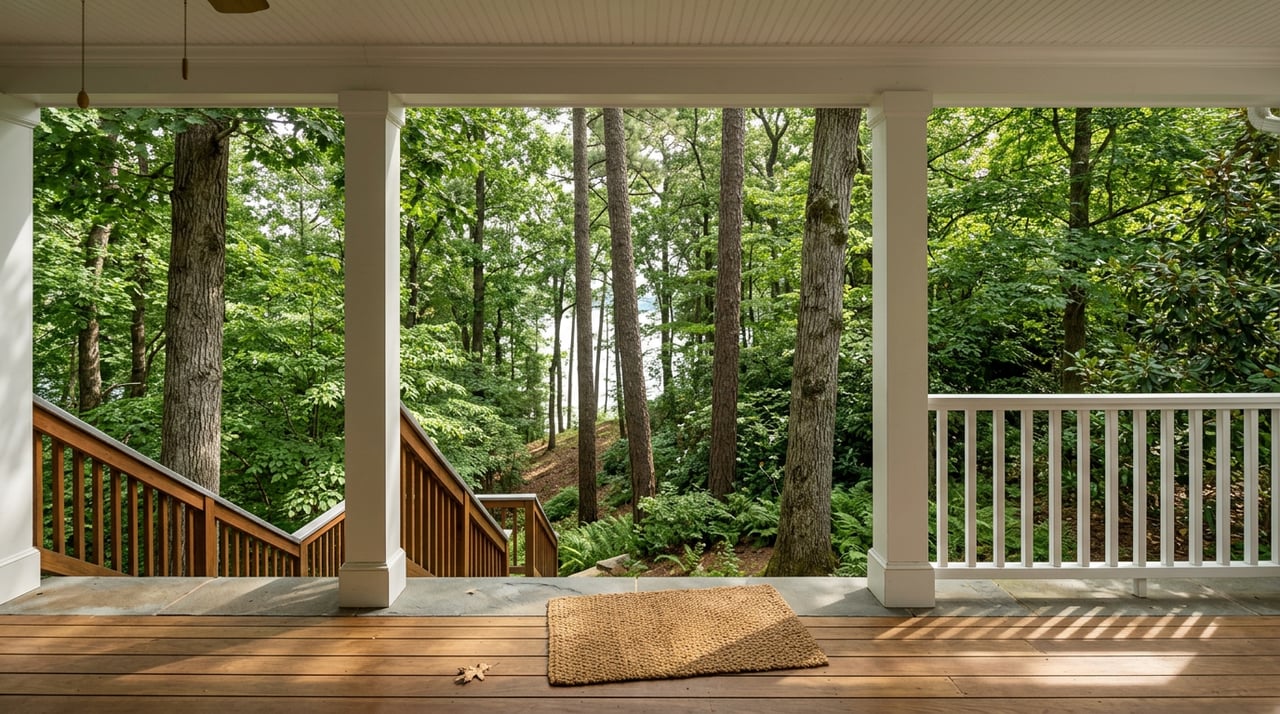
Two lots sit side by side on the same cove. Both list as waterfront. One is asking $340,000 and the other $585,000. The shoreline footage is nearly identical. The trees are the same. The view is the same.
The prices are not a mistake. They reflect something most buyers never think to ask about until an inspection period is already ticking.
The question that quietly reprices every lot
Every waterfront lot on Lake Keowee sits inside a regulatory system administered by Duke Energy. Duke has developed a Shoreline Management Plan that guides construction, shoreline stabilization, and excavation within the lake boundaries of Lake Keowee and Lake Jocassee, with the goal of continued public and private access while protecting natural resources. Duke is the Federal Energy Regulatory Commission licensee for the Keowee-Toxaway Hydroelectric Project (FERC No. 2503), which includes the Jocassee Development and the Keowee Development in upstate South Carolina and western North Carolina.
The consequence for a lot buyer is simple. "Waterfront" is a description of geography. "Dockable" is a permission. They are not the same thing, and the price gap between two lots almost always tracks the second.
A lot can carry beautiful shoreline and still be ineligible for a private dock because of shallow water, buffer classification, or covenants. Before an offer, the only answer that matters is one you get in writing from Duke Energy Lake Services, not one you infer from the listing photos.
The recording date on the plat controls what you can build
The size of the dock a lot can support is set less by how the shoreline looks today than by when the plat was recorded. This is the single most counterintuitive fact in the Lake Keowee lot market, and it is the reason two adjacent lots can carry very different values.
Under the current Shoreline Management Plan framework as summarized by local permit specialists:
| Lot recorded | Shoreline length | Dock size eligibility |
|---|---|---|
| Before Sept 1, 2006 | 75+ linear feet | Up to 10 sq ft of dock per linear foot of developable shoreline |
| Before June 1, 1996 | Less than 75 ft | Still eligible for 10 sq ft per linear foot |
| After Sept 1, 2006 | Less than 75 ft | Generally not eligible under the older allowance |
If a lot has at least 75 linear feet of shoreline and was subdivided and recorded prior to September 1, 2006, up to 10 square feet of dock per linear foot of developable shoreline may be allowed. Lots subdivided and recorded before June 1, 1996 with less than 75 feet of shoreline are also eligible for the 10-square-foot allowance, and a 1,000-square-foot cap applies to all docks regardless of linear shoreline.
A permitted dock can also carry up to 2 slips, plus a total of 2 personal watercraft docks or lifts that do not count toward the square-footage cap.
Read that table twice. A narrow-frontage lot recorded in 1994 may support a bigger dock than a wider-frontage lot recorded in 2010. That difference is worth real money. It is also invisible in the MLS photos.
Cove geometry finishes the equation
Even when a lot's paperwork clears the size hurdle, the water in front of it decides how the dock can be built. Two rules do most of the work.
Docks and piers may not extend more than one-third the distance to the opposite shoreline.
That 1/3-of-cove rule turns narrow, pinched coves into a real constraint. If the opposite shoreline is 120 feet away, your walkway plus dock cannot reach past 40 feet from your bank. Water depth at 30, 40, and 60 feet out determines whether a boat lift will operate, so most buyers who know the lake ask for those measurements before making an offer.
The second rule is the neighbor line. All docks must sit at least 10 feet from the neighboring projected property line, and any infringement requires an Encroachment Agreement signed by the neighbor. A cove that appears wide open can become far more restrictive once the projected lines of two adjacent lots are drawn on paper. A dock that "obviously fits" in a sketch may need a signed release from a neighbor who has no obligation to sign.
There is one more geometry wrinkle worth knowing. Docks with any portion of the structure on the cove side wider than 6 feet must be shortened an additional 10 feet, so the effective reach is 1/3 of the cove minus 10 feet, in order to allow room for mooring a watercraft.
The 2025 fee reset changed the math on older listings
Older blog posts and permit primers still quote a $350 application fee to Duke Energy. That number is out of date.
As of January 15, 2025, new applications for private docks or shoreline stabilization within the project boundaries require a $500 fee payable to the KT Habitat Enhancement Program in addition to the $500 fee payable to Duke Energy Lake Services. If a single application covers more than one activity, such as a dock and shoreline stabilization, each fee is paid only once, so applying for both together avoids paying the Habitat Enhancement fee twice.
Fees are only the sticker cost. The bigger consequence is timing. Certain times of the year the permitting process takes longer because of demand, and while Duke Energy targets 20 to 30 days for issuing permits, some circumstances extend that turnaround. Lake permits are valid for only one year. A permit issued in April that expires unused in April of the following year forces a fresh application, fresh fees, and a fresh place in the queue.
For a buyer planning to close, permit, clear, build a driveway, and then build a dock, a delay of even six weeks can push the project into the next construction season.
County buffers stack on top of Duke's rules
Both Oconee and Pickens counties have their own buffer requirements, and buyers are directed to contact the applicable county for details. These county buffers can restrict where a home footprint sits relative to the shoreline, independent of anything the Shoreline Management Plan requires. A lot on the Pickens side and a lot on the Oconee side can look identical on the plat and yield different building envelopes once county setbacks are applied.
Ask the buffer question before you fall in love with a house plan.
What already-in-place infrastructure is actually worth
The waterfront lot market in mid-2026 finally has options that were not there a year ago. Buyers touring today are choosing among raw lots, partially improved lots, and lots that arrive with a permitted dock in place. The list prices can look similar. The real value is not.
A lot that already carries:
- A permitted, tagged dock with an active transfer path
- A driveway cut and graded down to the building pad
- Utilities stubbed to the property line
- A permitted septic layout with soil suitability confirmed
can be worth meaningfully more than a raw neighbor with a comparable ask, because each of those line items is infrastructure the next buyer would otherwise pay for at today's cost, on today's timeline, subject to today's permit queue.
The dock in particular deserves attention. Before finalizing a sale that involves an existing dock, both parties should apply for and receive approval through Duke Energy so the utility has a permit on file for the dock's location before issuing the new permits. A dock that transfers cleanly is an asset. A dock without a clean permit history is a liability disguised as one.
The offer-stage checklist
If you are about to write an offer on a waterfront lot, get these seven items in writing before your due diligence clock burns out:
- Recording date on the plat, and linear feet of developable shoreline.
- Water depth measured at 30, 40, and 60 feet from the shoreline.
- Cove width to the opposite shoreline at the proposed dock location.
- Shoreline classification under the Shoreline Management Plan, verified with Duke Energy Lake Services.
- County buffer requirements from Oconee or Pickens County for the specific parcel.
- Status of any existing dock permit, tag number, and the transfer path through LAPS.
- Whether adjacent projected property lines create an encroachment issue that would require a neighbor's signed release.
The listing agent may have some of these. The seller may have others. Duke Energy Lake Services is the only source that binds.
FAQ
Are docks removed for winter on Lake Keowee? No. Lake Keowee does not freeze, and Duke Energy maintains water levels year round, so docks are permanent fixed or floating installations rather than seasonal removals typical of northern lakes.
Can a two-story dock be built? Decks, gazebos, covered boat slips, and boat shelters must be single-story structures. They may be roofed and designed to allow second-story sundeck use, but the second story cannot itself be roofed, which would create a two-story roofed structure.
How long is a dock permit good for? Lake permits are valid for only one year, and if a permit expires before the work is complete, a new application must be submitted, so lining up a contractor before applying is advisable.
Ready to look past the list price
The lots that end up being worth the money on Lake Keowee are not always the ones with the widest shoreline or the flashiest listing photos. They are the ones whose paperwork, cove geometry, and permit history point in the same direction. That is a determination that gets made lot by lot, not by scrolling.
If you are weighing a specific parcel and want a candid read on what its dock rights and building envelope actually look like, Amy Twitty walks the property, pulls the plat, and reads the shoreline classification with you before your offer goes in. Start Your Lake Keowee Search and bring the address of any lot you are considering. The rest of the diligence gets easier once the dock question is answered.
